
Finding Kearny Resident Records
Kearny has no one master roll of every resident. The useful record trail is divided between the Town, Hudson County, New Jersey agencies, and local history collections. An address is usually the strongest opening because it can be translated into a parcel, block, lot, and recorded instrument. A known name calls for a narrower check: the voter-status route, a court party search, a historical directory, or a vital-record request when eligibility permits. Each result should be kept with its date and role. A deed party, directory occupant, voter-status result, and property-card owner are different kinds of evidence.
Begin with the record closest to the question, then seek a second independent match. A current property record may name an owner or mailing address, but it does not establish every person in a household. A directory may place a household at an address in a particular year, but it cannot prove a present location. Kearny research works best when a reader records the exact spelling, source, date, municipality, and address rather than combining partial matches.
- Write down the current street address, municipality, and any block or lot already known.
- Use the New Jersey parcel route or ask the Kearny Assessor for the property-card and tax-map record.
- Search the Hudson County Register’s Acclaim index by legal description or by the exact party name.
- For a historical household, check the Kearny Library’s digitized directory runs and their Street Guide.
- When a public index is incomplete, make a focused request to the correct custodian under OPRA or use the counter and archive fallback.
Note: A missing online result can reflect a redaction, an indexing gap, a different jurisdiction, or a paper-only record.
Kearny Records Offices and Roles
Three offices matter most when a Kearny residents directory search moves from a name to a record. The Kearny Assessor maintains tax maps, property record cards, new-owner records, subdivision information, and assessment changes. The Hudson County Register preserves recorded land instruments. Hudson County election offices administer the wider election-record route, while the state status tool answers a limited registration question. They are not interchangeable. The Assessor’s public page did not expose an owner-name search form, so an office inquiry or narrow records request is the documented fallback.
Hudson County Register
257 Cornelison Avenue, 2nd Floor
Jersey City, NJ
(201) 395-4760
Kearny Tax Assessor
Town assessment administration
Kearny, NJ
Use the Town department directory
Hudson County Election Offices
257 Cornelison Avenue, 4th Floor
Jersey City, NJ
County Clerk: (201) 369-3470
Kearny Parcel Records by Address
For an address-led Kearny residents directory search, keep the municipal parcel and the postal address separate. The New Jersey GIS Property Explorer accepts an address, county, municipality, block, or lot. Its parcel identifier follows the statewide PAMS pattern. Select Hudson County and Kearny, then save the block and lot before moving to land records. A parcel map is a spatial and assessment aid, not proof that a named person presently lives there. Hosted owner data may be redacted under Daniel’s Law, and adjacent county edges may not join perfectly.
| Parcel field | Use in Kearny research |
|---|---|
| Address | Find the mapped parcel; preserve the source spelling and street suffix. |
| County and municipality | Select Hudson and Kearny to reduce similarly named places. |
| Block and lot | Carry this stable key to the Assessor and Register. |
| PAMS identifier | Connect state parcel data to the municipal tax-lot context. |
The Assessor maintains property cards, tax maps, ownership updates, subdivisions, and assessment changes, but no official public Kearny owner-search form was located. Ask for the specific card, map sheet, or assessment period instead of assuming the map supplies every field.
Kearny Deed Index Search Routes
Hudson County’s Acclaim index is the formal-instrument route for Kearny. It separates searches by grantor or grantee, book and page, instrument number, legal description, document type, consideration range, and record date. Start with the legal-description fields when a parcel key is known. A name search can follow, using initials, punctuation, married names, and other spelling variations. The Register says both computerized and hard-copy property indexes are available, which matters because Acclaim does not state an online historical cutoff.
Hudson County Acclaim displays the entry routes that make a precise search possible.
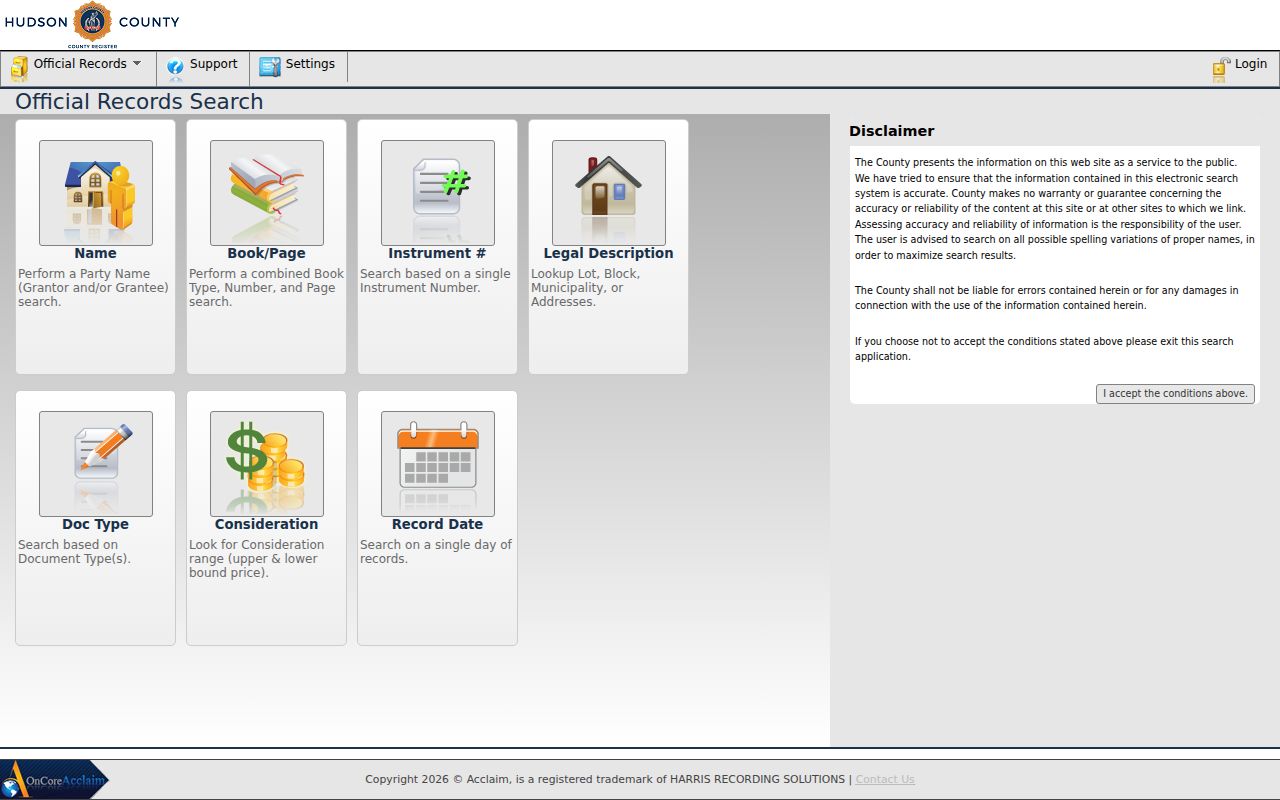
Use an instrument as evidence of a recorded transaction, not automatic evidence of occupancy. A mortgage, discharge, lien, map, or easement serves a different legal purpose than a deed. When the web search fails, ask the Register about the computer or hard-copy index using the municipality, block, lot, party variants, and an approximate record date.
- Grantor
- The party transferring or conveying an interest in an instrument.
- Grantee
- The party receiving that interest, who may be a person, estate, or organization.
- Legal description
- The lot, block, municipality, or other formal parcel description used to identify land beyond a street label.
Kearny Recording Alerts and Copies
The Hudson County Register is the appropriate Kearny custodian for deeds, mortgages, liens, easements, maps, discharges, and other recorded instruments. Its public office is at 257 Cornelison Avenue, second floor, Jersey City. Search and cashier service is listed for weekday daytime hours, while the site separately lists customer-service phone hours. Confirm both before going. The Register also links recording and copy-fee schedules, so a requested document should be identified by instrument number or book and page before a copy is ordered.
The Hudson County Register explains the office route and its public record services.
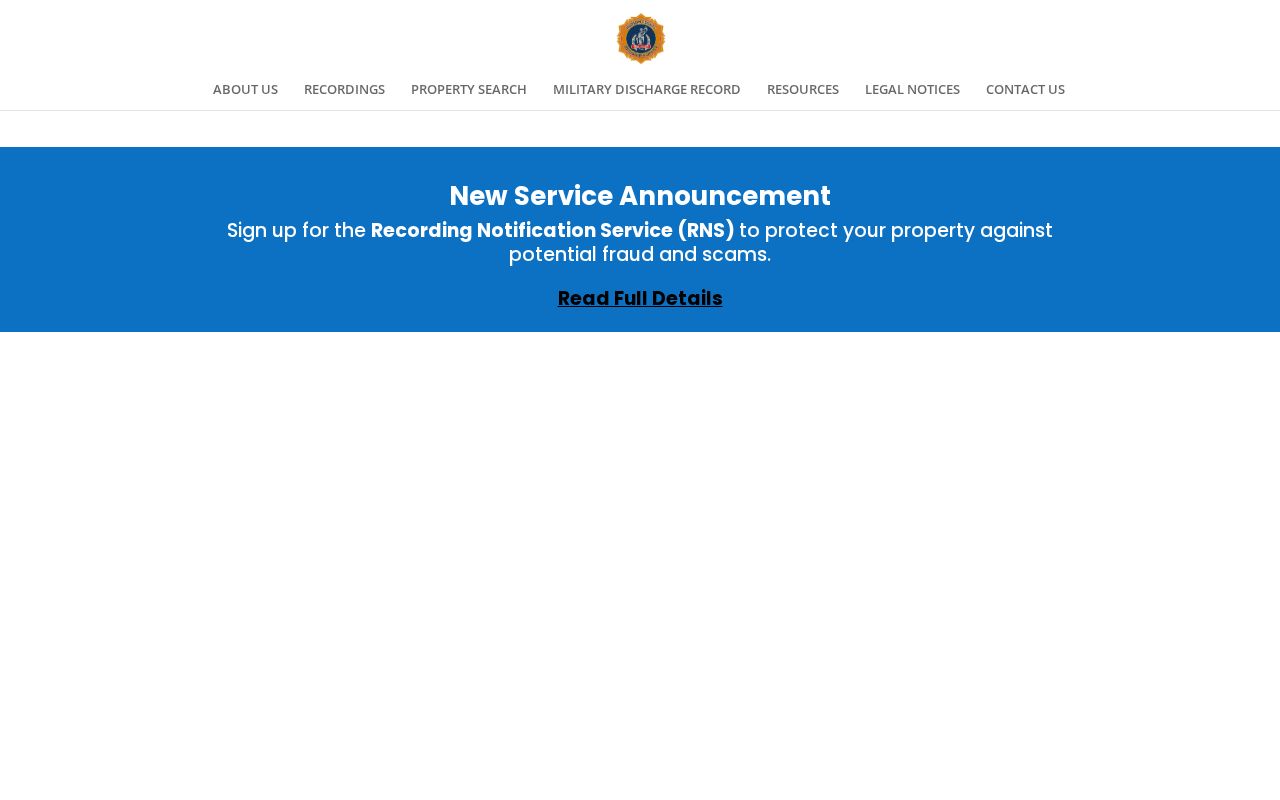
Its free Recording Notification Service can monitor up to ten properties or names per email with a name, address, lot, block, and municipality. An alert is not a title opinion and does not replace a historical search. If a notice or paid mailer looks suspicious, verify the document through the Register rather than using the mailer’s contact details.
Current Kearny Resident Sources
Current Kearny resident sources are purpose-built records, not a general directory. The assessment route associates a parcel with tax administration and may include a mailing address. The Register’s index identifies recorded parties. New Jersey’s voter status tool returns a narrow registration result, while a broader voter file has legal controls and protected-address redactions. State business and professional-license systems can confirm a filing or credential, but neither establishes a private home address. Treat each source as a dated record with a defined scope.
| Kearny record source | What it can establish | Custodian | Documented route |
|---|---|---|---|
| Assessment card and tax map | Parcel, situs, assessment association, possible mailing record | Kearny Assessor | Office, phone, or focused request |
| Registration-status lookup | Limited current registration status using exact-name handling | NJ elections | Official status portal |
| Recorded-instrument index | Parties, document type, dates, legal description | Hudson County Register | Acclaim plus hard-copy fallback |
| Business or license record | State filing or displayed current credential | NJ Revenue or licensing board | Official state search |
| Community organization listing | Public institution and meeting-place context | Town of Kearny | Official organizations page |
For one-person corroboration, use the Kearny resident lookup route to compare the person’s name, date, record role, and official source. Do not turn a business principal, license holder, or deed party into a current-residency claim without independent and lawful support.
Kearny Voter Status Is Limited
New Jersey’s voter registration status search is useful only for the narrow status question it is designed to answer. The research found guidance to use the name exactly as county records it, then try hyphen, space, and middle-initial variations rather than guessing that two similar names match. A voter status is not a household list, and an inactive result is not proof that someone moved away. The State describes an inactive record as potentially tied to an address question, including returned or moved ballot mail.
New Jersey’s voter status route is the official starting point for that limited check.
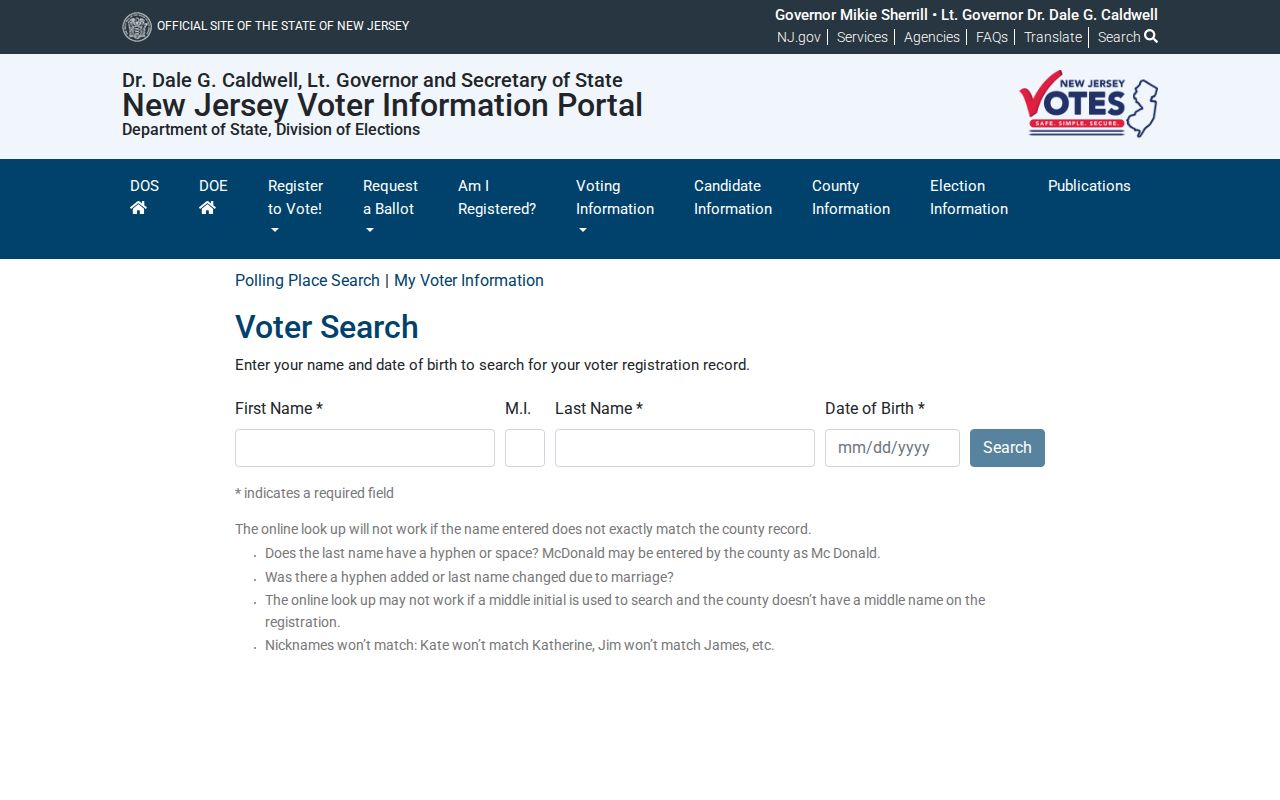
A broader voter-file request belongs with the appropriate county custodian and remains subject to use rules, redactions, and protected-person exceptions. Kearny’s Town Clerk links to registration, polling-place information, results, and sample ballots for the town’s wards. Ballots identify public election context, not a list of people living on a street.
Kearny Court and Vital Checks
A court record and a vital record answer very different questions in a Kearny residents directory search. New Jersey Courts separates civil and foreclosure jackets, criminal routes, judgments, Tax Court matters, and municipal cases. The Electronic Case Jacket party path uses individual or business selection, required first and last name, optional middle initial, and a reCAPTCHA. A jacket can contain a case summary and e-filed documents, but it may omit pre-eCourts paper, discovery, unuploaded material, and protected records. A missing document is a reason to ask the court clerk, not proof that an event did not occur.
New Jersey Courts search routes distinguish the case families and their access points.
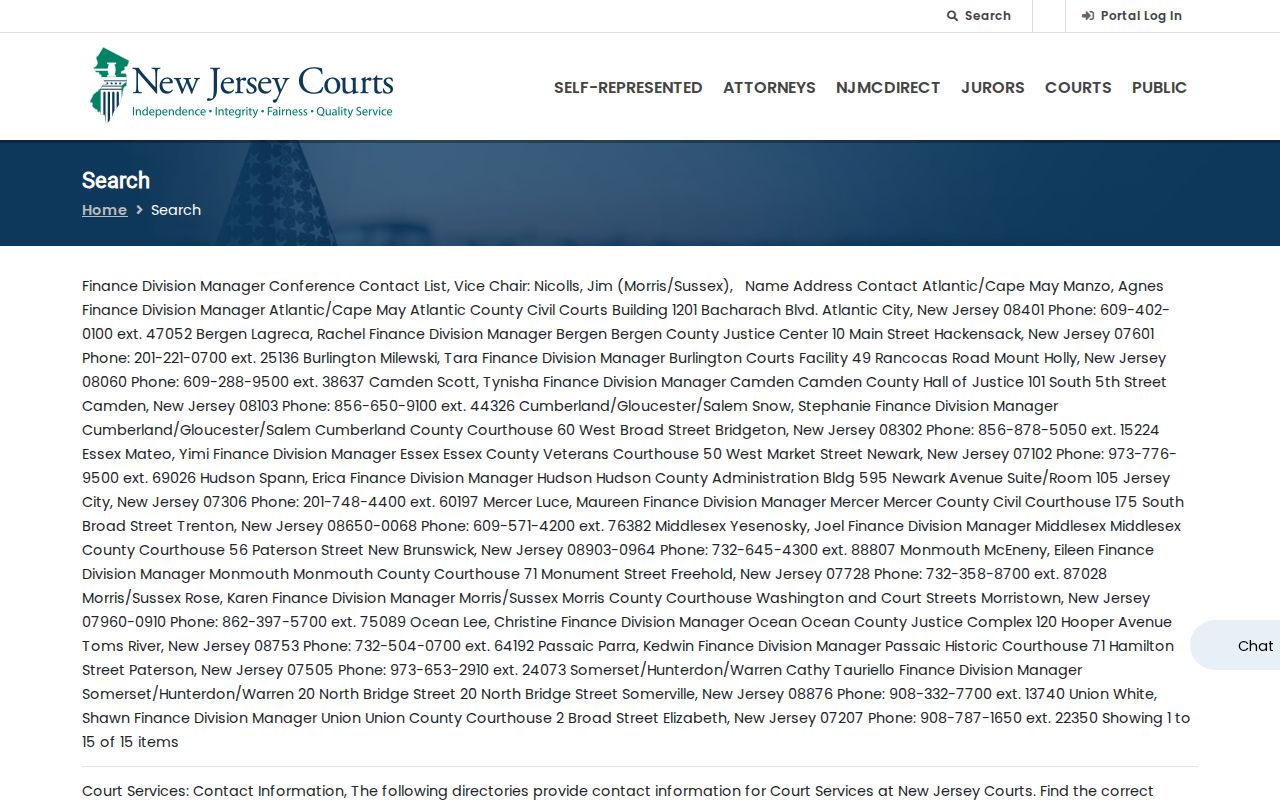
Kearny vital events follow a separate custodial path. The local registrar and the New Jersey Department of Health do not provide an unrestricted public online name index. Certified and genealogical requests have distinct eligibility, identity, fee, and age-threshold rules. For older series, the State Archives is the identified route.
New Jersey Vital Statistics explains the state record categories and request boundary.
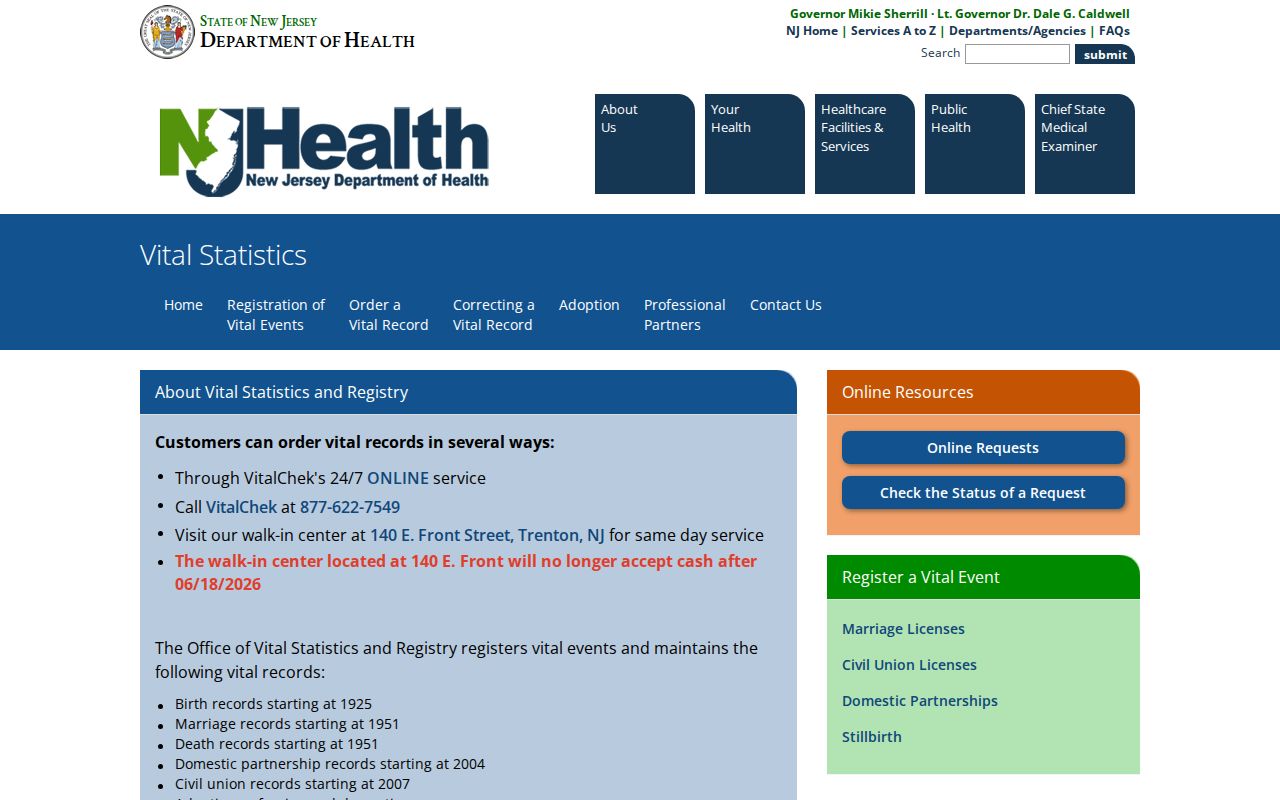
Use a birth, death, marriage, or other event only as allowed by the custodian. A vital record can confirm an event when eligibility permits; it is not a public shortcut for locating a living person.
Historical Kearny Resident Directories
Kearny Public Library’s digitized directory archive is the core historical residents directory source. Located runs are 1890, 1895, 1913, 1915, 1917, 1920, 1924, 1927, 1928, and 1929. The collection’s geographical labels shift: the 1890 run has Harrison and Kearny sections; the 1895 run adds Arlington; the 1913 through 1920 runs include East Newark; and the 1924 through 1929 runs add North Arlington. Those labels are part of each publication’s scope, not modern boundary evidence.
Use the Street Guide alongside the alphabetical sections. The 1890 archive navigation includes a Kearny Section and Street Guide. The 1913 navigation includes a Street Directory, two directory parts, a business directory, appendices, and introductory material. The library archive did not identify the publisher on its catalog page, and a readable sample entry was not captured during research. Transcribe only fields visible in a scanned volume. The full year-by-year collection work belongs in the Kearny city directories.
Kearny Genealogy Record Thresholds
Vital records are often more useful for a past Kearny family than for a current search. New Jersey’s genealogy guidance sets different age thresholds for births, marriages, and deaths, and the subject must meet the stated deceased-person and series limits. The local Kearny registrar identifies a local request route, while the State Archives holds older vital series. Requesters should provide the event type, subject’s name, Kearny or Hudson County location, and year, then follow the custodian’s identity and relationship rules. A genealogical copy is a research record and should not be treated as the same thing as a certified copy.
New Jersey’s genealogical vital-record guidance sets out the record-specific request path.
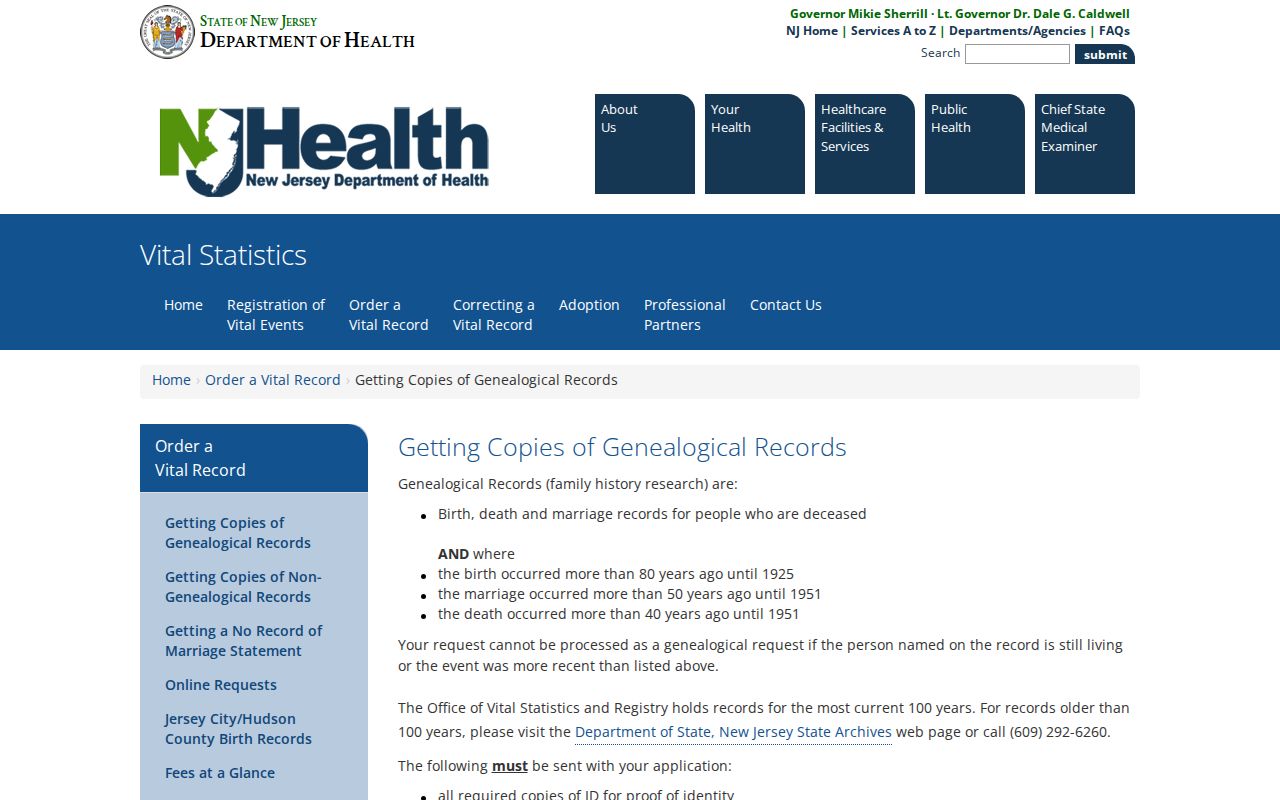
The State Archives identifies births from 1848 through 1925 and marriages and deaths from 1848 through 1950 in its historical holdings. Earlier Kearny-area work may also require the right county context because Hudson County was formed from Bergen County in 1840.
Kearny OPRA Records Requests
When a Kearny record is not searchable online, New Jersey’s Open Public Records Act, N.J.S.A. 47:1A-1 et seq., is the documented request route. Send a written request to the office that actually holds the record. A request for a property card belongs with the Assessor; an instrument belongs with the Register; a municipal form, minutes, or license question may belong with the Town Clerk. Identify the address or name, record type, date range, and preferred delivery method. A generic request for all records about a person is less useful and may not identify a proper government record.
New Jersey’s OPRA request guidance explains how to route a request to the appropriate custodian.
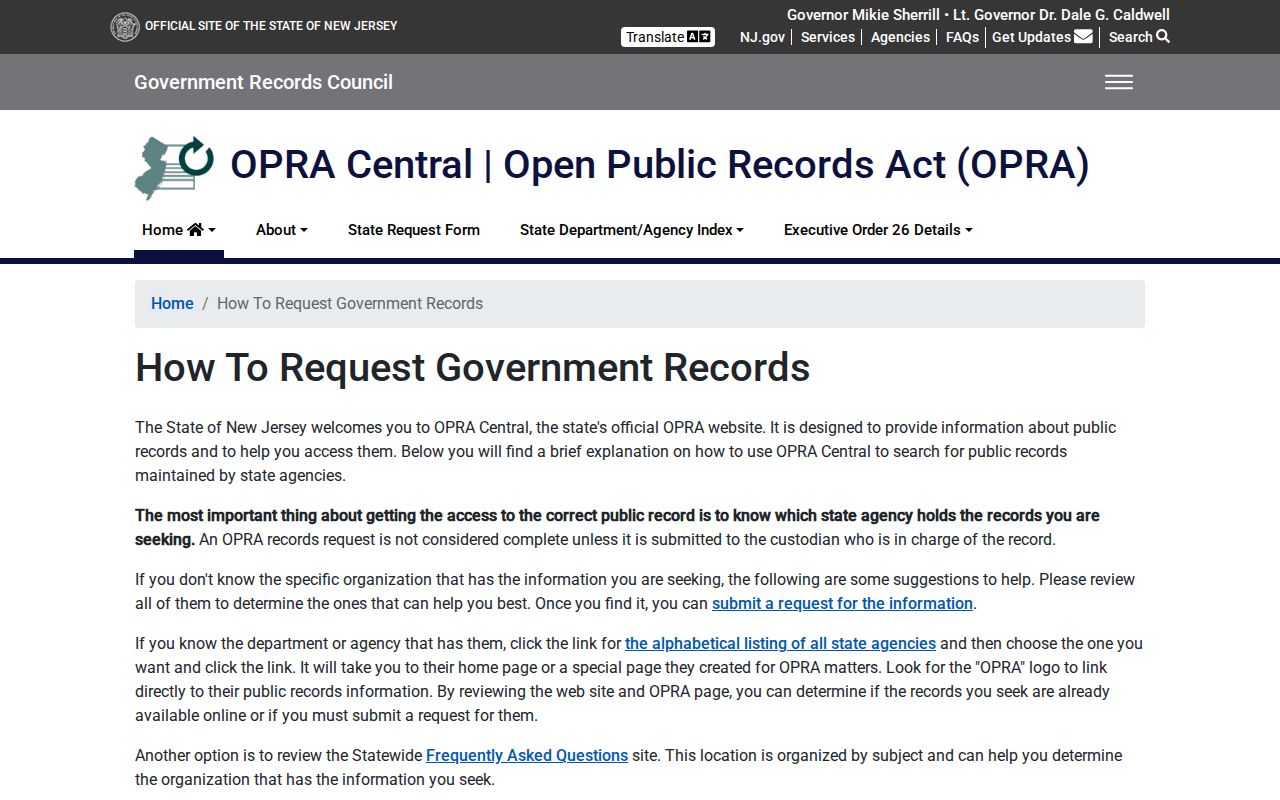
The current Act describes a general seven-business-day response period, with exemptions and special review periods that can affect access. The research found statutory per-page copy rates, but requests can also involve actual delivery or material charges. Confirm current fees and instructions before submitting payment.
Kearny Resident Privacy Boundaries
Public availability has limits. New Jersey’s Address Confidentiality Program provides a substitute address for eligible participants, while Daniel’s Law can redact covered people’s home addresses from parcel, voter, and related government datasets. Courts can withhold sealed, expunged, juvenile, family, or non-electronic material. Vital records require eligibility. Motor-vehicle data is separately restricted. Do not treat an absent address or redacted owner field as an invitation to reconstruct it from other records.
Lawful personal use. Kearny records are best used for family history, property research, civic questions, and other lawful personal purposes. Never use information from a record to stalk, harass, intimidate, or harm anyone.
Official sources can also help prevent scams. The Register’s free recording alerts and the State’s free unclaimed-property search are safer starting points than an unsolicited message requesting payment. Preserve a questionable notice, verify it through the official agency domain, and report deceptive demands through the proper government or consumer-protection channel.